By the end of 2026, your backyard could be generating more monthly revenue than a traditional investment account, provided you don’t get buried in the paperwork first. Many homeowners in cities like Corona and Temecula feel overwhelmed by the shifting landscape of California housing laws and the technical hurdles of utility connections. It’s frustrating to face the threat of project delays or contractor ghosting when you’re simply trying to build a legacy for your family.
Finding a reliable ADU builder Riverside County residents can trust means looking for a partner who prioritizes fixed-price certainty and regulatory precision. This guide provides the expert roadmap you need to secure permits, manage costs, and complete a compliant backyard casita without the typical construction headaches. We’ll break down the 2026 permit requirements, explain the impact fee waivers for units under 750 square feet, and outline the exact steps to achieving a turn-key rental property or guest house.
Key Takeaways
- Learn how Riverside County’s “Objective Standards” simplify the approval process for residential properties in unincorporated areas.
- Compare the benefits of detached versus attached ADUs to determine which model best balances your privacy needs with your construction budget.
- Understand the critical early phases of the construction timeline, including site preparation and the complexities of underground utility trenching.
- Discover why partnering with a veteran ADU builder Riverside County trusts can eliminate the risk of hidden invoices through fixed-price construction agreements.
- Explore how the 2026 housing market has redefined property value, making strategic backyard density a premium asset for local homeowners.
The Rise of ADUs in Riverside County: Why Now is the Time
The 2026 Riverside County housing market has reached a turning point where property density is no longer just a trend; it’s a premium asset. Homeowners in cities like Corona and Temecula are looking at their backyards with a new perspective, recognizing that land is the most valuable component of their primary residence. This shift is largely driven by the evolution of California state laws, including SB 9 and SB 10, which have effectively stripped away many of the local roadblocks that previously made adding a second unit nearly impossible. These laws prioritize housing production, allowing you to bypass restrictive local ordinances that once dictated everything from parking requirements to architectural style.
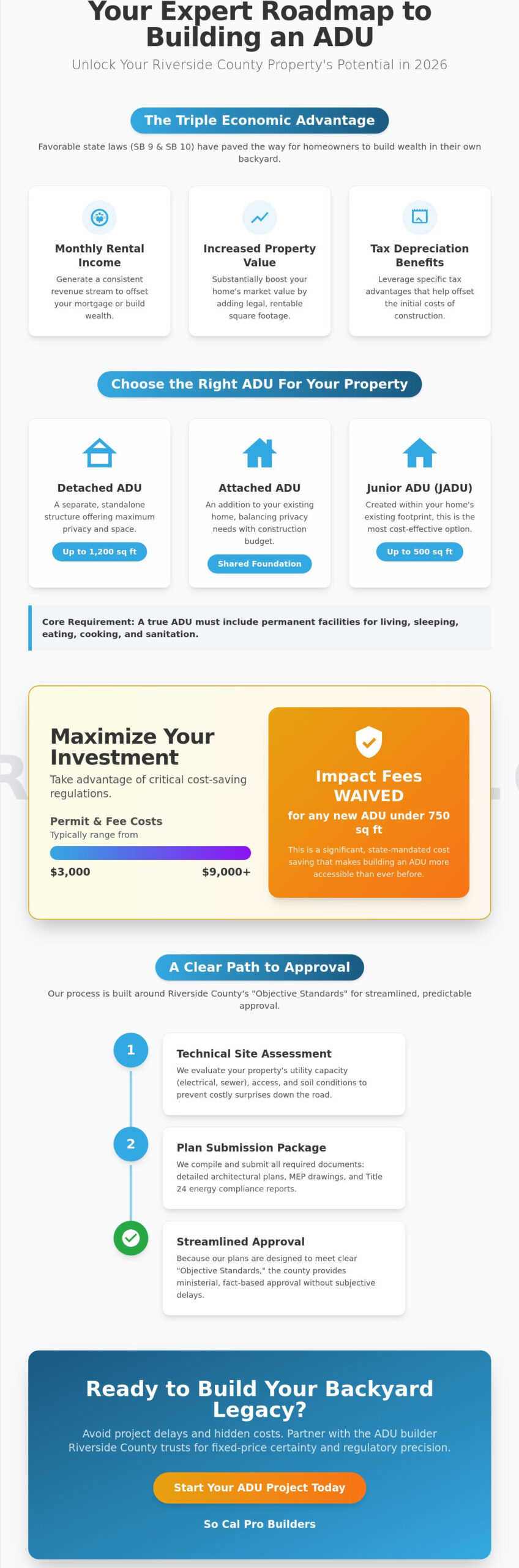
Securing a partnership with an experienced ADU builder Riverside County residents rely on is the first step in capitalizing on this legislative window. Beyond providing a place for family to stay, these units offer a triple threat of economic advantages. You gain immediate monthly rental income, a substantial increase in your property’s total market value, and specific tax depreciation benefits that can offset the costs of construction. For many, it’s a more stable and predictable path to wealth than traditional stock market investments or purchasing separate rental properties in high-priced coastal areas.
ADU vs. Casita: What is the Difference?
While people often use terms like “granny flat” or “backyard casita” in casual conversation, the technical definition under the California building code is an Accessory Dwelling Unit. A true ADU must include permanent provisions for living, sleeping, eating, cooking, and sanitation. In Southern California, a detached unit can be as large as 1,200 square feet, while a Junior ADU (JADU) is typically limited to 500 square feet and must be built within an existing structure. Whether you plan to use the space as a secluded home office, a guest house for visiting relatives, or a full-time rental, the occupancy rules are now more flexible than ever, reflecting the diverse needs of modern Riverside families.
Investment Potential in the Inland Empire
The Inland Empire is currently experiencing a surge in rental demand. This is fueled by the growing student population at UC Riverside and a workforce that prefers the space of Riverside County while commuting to nearby job hubs. Adding a unit to your lot increases your primary residence’s marketability by offering a “mortgage helper” for future buyers. The long-term ROI is particularly compelling when you consider that impact fees are currently waived for units under 750 square feet. This reduction in upfront costs, combined with the rising cost of traditional real estate, makes backyard construction one of the most fiscally responsible decisions a homeowner can make in 2026.
Navigating Riverside County ADU Permits and Regulations
Building an ADU in Riverside County involves understanding “Objective Standards.” These are clear, measurable rules that remove the guesswork from the approval process. If your design meets these specific criteria, state law requires a ministerial, streamlined approval. This means your project is evaluated based on facts rather than subjective opinions. Working with a seasoned ADU builder Riverside County homeowners trust ensures these standards are integrated into your architectural plans from the very beginning. While unincorporated areas fall under the jurisdiction of the Riverside County Planning Department, cities like Temecula or Moreno Valley often have their own specific nuances regarding utility tie-ins or exterior finishes.
Local utility hurdles are often the most complex part of the pre-construction phase. You’ll need to verify if your existing electrical panel has the capacity for an additional dwelling or if your sewer line requires a new lateral connection. In Moreno Valley, for instance, specific drought-tolerant landscaping might be required to meet local water conservation goals. An experienced ADU builder Riverside County residents rely on will perform these technical assessments early to prevent costly mid-project corrections. Addressing these logistical realities before submitting your plans is the best way to ensure a predictable construction schedule.
The Permitting Roadmap: From Submission to Approval
Your permitting roadmap starts with a comprehensive submittal package. This includes detailed site plans, Mechanical, Electrical, and Plumbing (MEP) drawings, and Title 24 energy compliance reports. Total permit and fee costs typically range from $3,000 to $9,000, depending on the complexity of your site. To accelerate the process, some jurisdictions offer permit-ready “standard” plans. These pre-approved designs can reduce your plan check fees, which usually range from $350 to $1,800, and help you get to the construction phase faster.
Zoning Setbacks and Lot Coverage Rules
Zoning rules dictate exactly where your unit sits on the property. For most detached units, you must maintain a minimum setback of 4 feet from the side and rear property lines. Height restrictions are equally firm; detached ADUs are limited to a maximum of 16 feet. This height limit generally favors single-story designs to maintain neighbor privacy. One of the most significant 2026 regulatory benefits is the parking exemption. You don’t need to provide additional off-street parking if your property is within a half-mile of public transit, such as a Riverside Transit Agency (RTA) bus route.
Choosing the Right ADU Type for Your Property
Selecting the specific blueprint for your project is a decision that balances your property’s physical layout with your long-term financial goals. Every lot in Riverside County presents unique opportunities, whether you’re working with a sprawling R-1 lot in Riverside or a more compact space in a newer Corona development. The four primary categories of units allow for a tailored approach. Detached ADUs remain the gold standard for those seeking maximum privacy and the highest potential rental income. These standalone structures provide a complete sense of separation from the main house. In contrast, attached ADUs offer a cost-effective expansion by utilizing at least one existing wall of your primary residence, which can simplify the structural engineering phase.
For homeowners looking to maximize existing square footage, garage conversions are a popular and efficient choice. Since the foundation and shell are already in place, the focus shifts toward interior transformation and utility integration. If your needs are more modest, a Junior ADU (JADU) provides a high-efficiency living space limited to 500 square feet. These must be contained within the existing structure of your home, making them ideal for multi-generational living or a dedicated home office. Partnering with a professional ADU builder Riverside County residents rely on helps you evaluate which of these structures will best serve your specific lot coverage limits and setback requirements.
Ground-Up Construction vs. Conversions
The choice between building from the ground up or converting an existing space often comes down to the condition of your current structures. Older garages in Riverside may require foundation retrofitting or wall plate height adjustments to meet 2026 California building codes. While conversions often have a shorter construction timeline, new detached builds offer complete design freedom. Utility connections also differ significantly; a detached unit requires independent trenching for sewer and water lines, whereas an attached unit or JADU might share existing plumbing stacks, provided the capacity is sufficient for the additional load.
Designing for the Southern California Lifestyle
A successful design must account for the specific climate of the Inland Empire. We prioritize indoor-outdoor flow by integrating hardscapes and patios that effectively double the usable living area of a small unit. Because summer temperatures in cities like Temecula often exceed triple digits, high-efficiency cooling systems and advanced insulation are non-negotiable. We focus on modern finishes and architectural details that seamlessly match your existing home. This ensures that the new addition feels like a natural extension of your property’s heritage rather than an afterthought. An expert ADU builder Riverside County homeowners hire will ensure the final aesthetic enhances your neighborhood’s character while providing a sanctuary for your tenants or family. Homeowners in the area who want to further elevate their property’s interior appeal often pair their ADU project with a kitchen remodeling Temecula CA upgrade to maximize the overall value of their investment. Many of these same homeowners also invest in a bathroom remodeling contractor Temecula residents trust to create a spa-like master suite in their primary residence, ensuring the entire property reflects the same level of high-end craftsmanship.
The ADU Construction Timeline: What to Expect
The construction of a backyard casita is a methodical progression that transforms a design plan into a functional living space. For a detached unit, this process typically spans 8 to 12 months, while an attached unit might be completed in 6 to 9 months. Phase 1 begins with site preparation and underground utility trenching. This is a critical stage where your ADU builder Riverside County specialist ensures all sewer, water, and electrical lines are correctly positioned before any concrete is poured. Phase 2 follows with the foundation pour and rough framing, providing the first physical glimpse of the structure’s footprint and scale.
Phase 3 shifts the focus to the internal systems, including Mechanical, Electrical, and Plumbing (MEP) installations. This stage requires rigorous inspections from Riverside County officials to verify that every component meets current safety codes. Once the systems are cleared, Phase 4 introduces the interior finishes, such as cabinetry, flooring, and paint. This is when the architectural vision truly comes to life. The process concludes with Phase 5, which involves a final walkthrough and the issuance of a Certificate of Occupancy. This document is your official green light to move in tenants or family members, signifying that the build is fully compliant and ready for use.
Managing Site Logistics in Residential Neighborhoods
Building in an established neighborhood requires careful coordination to minimize disruption to your daily life. We prioritize staging materials in limited backyard spaces to keep driveways and sidewalks clear. Compliance with local noise ordinances and work hour regulations is a standard part of our operational plan to maintain positive relationships with your neighbors. We also take specific measures to protect your existing landscaping, hardscapes, and pools from construction debris or heavy equipment movement during the more intensive phases of the build.
The Importance of Licensed Oversight
A general contractor acts as the central hub for all trade coordination, ensuring that plumbers, electricians, and framers work in sync. This professional oversight is vital for navigating mandatory inspections and maintaining the project’s momentum without unnecessary delays. Before hiring any ADU builder Riverside County offers, verify that they carry active liability and workers’ compensation insurance. This protection secures your property and financial interests throughout the entire duration of the project. Contact us today to start planning your backyard project with a licensed expert.
Why So Cal Pro Builders is Riverside’s Trusted ADU Partner
Choosing an ADU builder Riverside County homeowners can rely on involves more than just reviewing a portfolio. It requires a partner with a deep understanding of structural integrity and local regulatory nuances. Led by Jesus Flores, So Cal Pro Builders brings over 30 years of local craftsmanship to every backyard project. Our extensive background in emergency restoration has instilled a “structure-first” philosophy that ensures your new build is as durable as it is beautiful. We treat every casita as a lasting legacy, prioritizing meticulous planning and long-term protection over quick, surface-level transactions.
We serve a broad territory across the Inland Empire, providing comprehensive construction services from Murrieta to Chino Hills. This regional experience is vital because it means we understand the specific soil conditions, climate demands, and city-level building departments that define our local landscape. Whether you’re adding a guest house in Riverside or a rental unit in Corona, our team provides the calming, authoritative presence needed to guide you through the financial and design decisions of a major build. This seasoned, hands-on approach ensures that your project remains grounded in the physical and logistical realities of the trade.
The Fixed-Price Advantage for Homeowners
Budget uncertainty is one of the primary fears homeowners face when starting a construction project. We address this directly by offering fixed-price construction fees that eliminate the risk of “hidden surprise” invoices. Our process begins with cost-effective planning, where we provide a transparent budget for labor, materials, and specialized trades before the first shovel hits the ground. This disciplined approach to fiscal responsibility ensures that we finish your project on time and within the agreed scope. It allows you to focus on the future value of your investment rather than unexpected costs.
Local Expertise Across the Inland Empire
Our deep roots in communities like Temecula, Corona, and Moreno Valley have allowed us to build a robust network of local specialized trade partners. This familiarity ensures that every phase of your project is handled by professionals who understand local standards and expectations. We take visible pride in the growth of our organization and the heritage of craftsmanship we bring to every property. Beyond ADU construction, our clients in Temecula frequently explore our luxury kitchen remodeling Temecula CA services to complement their property upgrades with a fully redesigned interior space. Contact So Cal Pro Builders today for an ADU consultation to see how our experience can secure the future of your backyard project. We’re here to help you navigate the complexities of construction with confidence and clarity.
Securing Your Backyard Legacy in Riverside County
Building a backyard casita is more than a construction project; it’s a strategic investment in your property’s long-term value. You’ve learned how the 2026 regulations favor homeowners and how specific zoning standards like the 4-foot setback dictate your site layout. Success depends on navigating these technical details with a partner who understands the local landscape and the nuances of the Inland Empire. By focusing on compliant designs and clear timelines, you can transform your underutilized land into a functional asset for your family or a steady stream of rental income.
Selecting an ADU builder Riverside County homeowners trust ensures your project benefits from a focus on structural integrity and transparent communication. We prioritize fixed-price project management to give you financial peace of mind from the initial site prep to the final inspection. As a licensed general contractor with over 30 years of experience, we specialize in Riverside County zoning compliance to keep your project moving forward without unexpected hurdles. Your vision for a backyard casita is within reach when you have a steady, professional guide leading the way.
Start Your ADU Project with a Free Consultation to see how our precision-led approach can bring your guest house or rental unit to life with confidence.
Frequently Asked Questions
How much does it cost to build an ADU in Riverside County in 2026?
Total construction costs vary based on the specific type of build and site conditions. While garage conversions are often the most economical choice, detached units involve separate trenching and foundation work. You should also account for the fact that Riverside County waives impact and school fees for units under 750 square feet. This can lead to significant upfront savings compared to larger structures that require more intensive utility upgrades.
Can I build an ADU on my property if I have a septic tank?
Yes, you can build with a septic system, but it requires a specific clearance from the Riverside County Department of Environmental Health. They’ll need to verify that your existing tank and leach field have the capacity to handle the additional flow. If the current system is insufficient, you might need to upgrade your tank or expand the disposal area to meet modern health and safety requirements for multiple dwellings.
How long does the permit process take in the city of Riverside?
The permit review process is generally streamlined due to state mandates, often requiring about 60 days for a ministerial review. This timeline can fluctuate based on the completeness of your submittal package and whether you’re using pre-approved standard plans. Working with a professional ADU builder Riverside County residents trust ensures your site plans and Title 24 reports are accurate from the first submission, preventing unnecessary delays with city officials.
Do I need to provide additional parking for my ADU tenant?
You don’t need to provide additional parking if your property is within a half-mile of public transit, such as an RTA bus route. Additionally, if you’re converting an existing garage or carport into an ADU, state law prevents the city from requiring you to replace those lost parking spaces. This makes it much easier to maximize your lot’s potential without sacrificing space for a new driveway or parking pad.
What is the maximum size for a detached ADU in Riverside County?
A detached ADU in Riverside County can reach a maximum size of 1,200 square feet. For attached units, the size is limited to 50% of the primary dwelling’s area, though it can still go up to that 1,200-square-foot cap. These generous limits allow homeowners to build full two-bedroom homes in their backyards, providing enough space for long-term tenants or multi-generational family members to live comfortably.
Can an ADU be sold separately from the main house in California?
Most ADUs must be sold as part of the primary property, but recent legislation like AB 1033 allows cities to opt into “condo-izing” these units. This would permit the separate sale of a backyard home if the local jurisdiction has adopted the necessary ordinances. Currently, most Riverside County properties treat the ADU as a secondary structure that stays on the same deed as the main house, enhancing the overall property value.
How does adding a casita affect my property taxes?
Adding a casita triggers a blended assessment, where only the value of the new construction is added to your property tax bill. Your primary residence won’t be reassessed at its current market value, which protects you from a massive tax hike. This targeted assessment ensures that your tax increase is proportional to the value of the new structure, making it a predictable part of your long-term financial planning.
Is a garage conversion cheaper than a ground-up ADU build?
Converting a garage is typically more cost-effective than a ground-up build because the foundation and structural shell are already present. However, you must ensure the existing slab is level and the walls meet current moisture barrier requirements. An experienced ADU builder Riverside County homeowners hire will assess if the cost of retrofitting an older garage outweighs the benefits of starting fresh with a custom detached unit tailored to your specific needs. Homeowners who pursue a garage conversion often take the opportunity to also work with a trusted bathroom remodeling contractor Temecula professionals recommend to upgrade the bathrooms in their primary residence simultaneously, maximizing the overall return on their home improvement investment.